 Deniz Bodur
Under Sofa Robot Vacuum Station
Concept
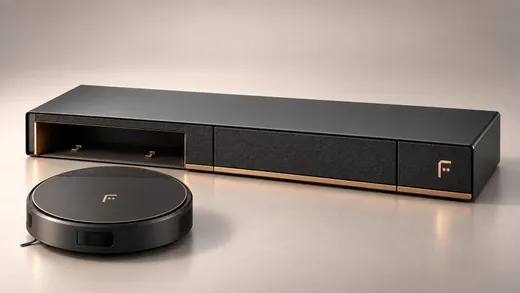
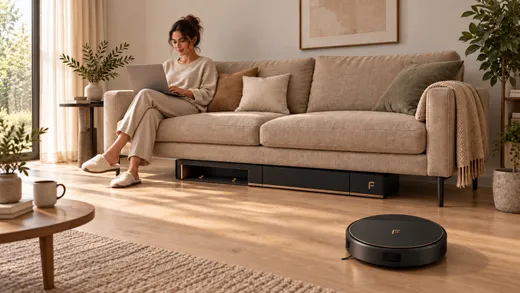
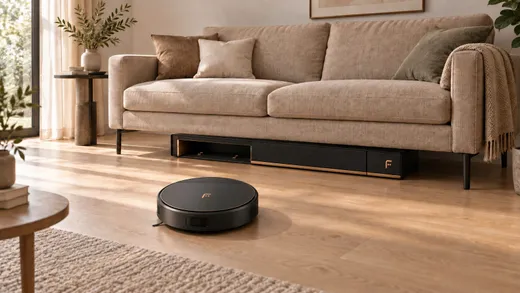
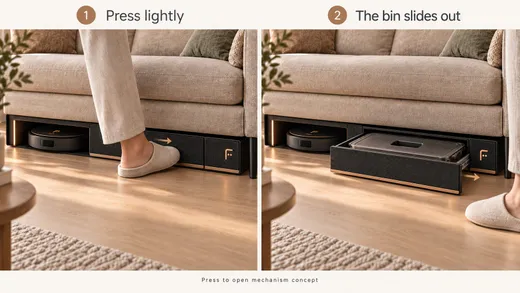
A robot vacuum and its dock usually need their own patch of floor, and in a small home that patch is expensive. This station is low, long and horizontal, so it slides under a sofa and the robot parks inside it, out of sight.
- Low horizontal body. It uses the gap under sofas that have enough clearance.
- Robot bay. The robot parks at one end, charges on contacts and is emptied into the station.
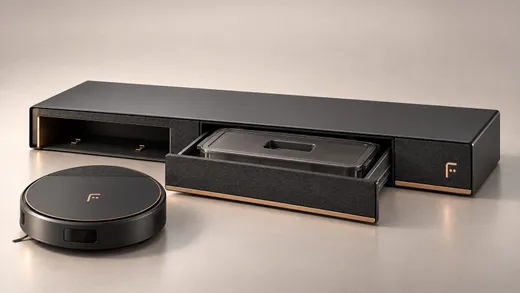
- Large front bin. A fully removable dust bin, reached from the front without moving the sofa.
- Press to open. A light press on the front panel opens the bin drawer.
Starting point
This is a concept exercise. The product is not meant to be sold or produced. The question I set myself: if Fakir designed a product like this, how would they approach it? What matters here is that approach, from the research to the renders. I wrote the whole design process myself.
Context
Homes in big cities are getting smaller and daily life is getting faster. In micro living every piece of floor has to earn its place, and people hand more routine chores to machines. The robot vacuum is a good example. It is becoming an ordinary household appliance, but its dock is still an extra object that stands in the middle of the living room.
The question of this project: where can a robot vacuum and its dock live in a small home without taking space?
User
The persona is fictional: a 31 year old graphic designer who lives in a compact one plus one flat and works in a hybrid way. The living room is a workspace during the day and a rest area in the evening.
“Cleaning should go on in its own flow. I don’t want to rearrange the living room to place the station.”
Why under the sofa
The sofa is already part of the living space. Models with enough clearance underneath offer a chance to hide the station inside the area the furniture already occupies. The low horizontal body uses this gap and aims to free the open floor of the room.
Design goals
- Finding a place. A position near an outlet that does not block the way.
- Visual order. Fewer devices around the rest area.
- Maintenance. Easy access to the bin, with the aim of emptying it less often.
The station needs clearance under the sofa and some free space in front of it for the bin.
Bin and press to open
The dust bin is large and fully removable. It sits in a drawer behind the middle section of the front panel. A light press on that panel releases the drawer, and only the drawer slides out, carrying just the bin on its rails. The air duct, filter, fan and electronics stay fixed in the end block, so nothing electrical moves and the bin comes out without moving the sofa. Pushing the drawer back in closes it.
How it works inside
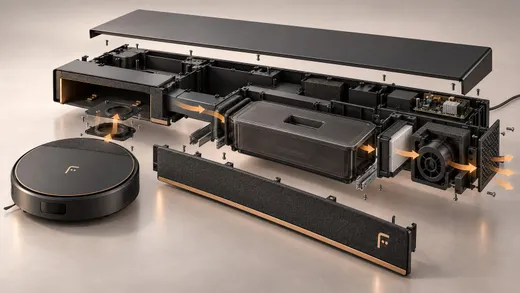
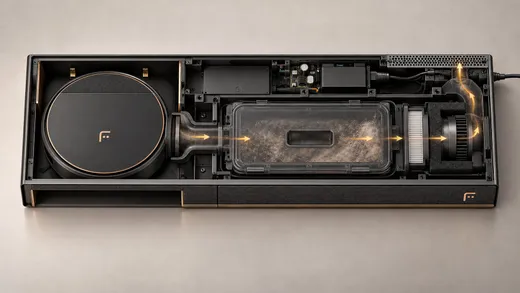
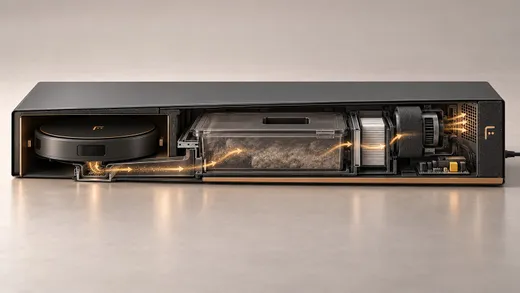
A normal robot vacuum dock stands upright. Here the same parts are laid out in a line, because the body is only as tall as the robot. The air path, from left to right:
- Robot bay. The robot parks against charging contacts on the back wall. A port in the floor of the bay lines up with the robot’s dust outlet and is sealed by a soft rubber gasket.
- Air duct. A flat rectangular duct runs horizontally from the port to the dust bin.
- Dust bin. The large bin slides on drawer rails and is sealed against the duct by a gasket when closed.
- HEPA filter. It sits after the bin, so only clean air goes on.
- Fan. The suction fan sits in a foam sleeve to keep it quiet.
- Exhaust. Clean air leaves through a perforated grille on the back wall.
The power supply board and the cable sit at the rear. This is a concept layout based on how existing docks work. It has not been engineered or tested.
Material language
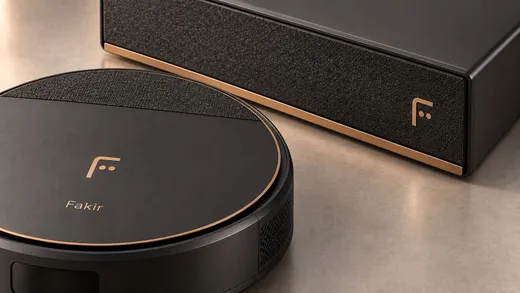
Matte anthracite body, dark textured fabric surfaces and thin bronze details. The robot, which has no mop, shares its surfaces and colours with the horizontal station, so the two read as one family.
Disclaimer
This is an independent concept exercise: the product is not for sale, was not commissioned by Fakir and is not affiliated with or endorsed by Fakir. The Fakir name and logo belong to their owner and appear here only to show the approach.
All renders, including the mechanism views, and the people in the scene images were generated with AI to visualize the concept (click a thumbnail to see it full screen). Details can differ from a real product.